
Weekend Getaways
7 Must-Visit National Parks in Thailand and How to Explore Them
Escape Bangkok for Thailand’s 7 best national parks. Discover wildlife, culture and ...


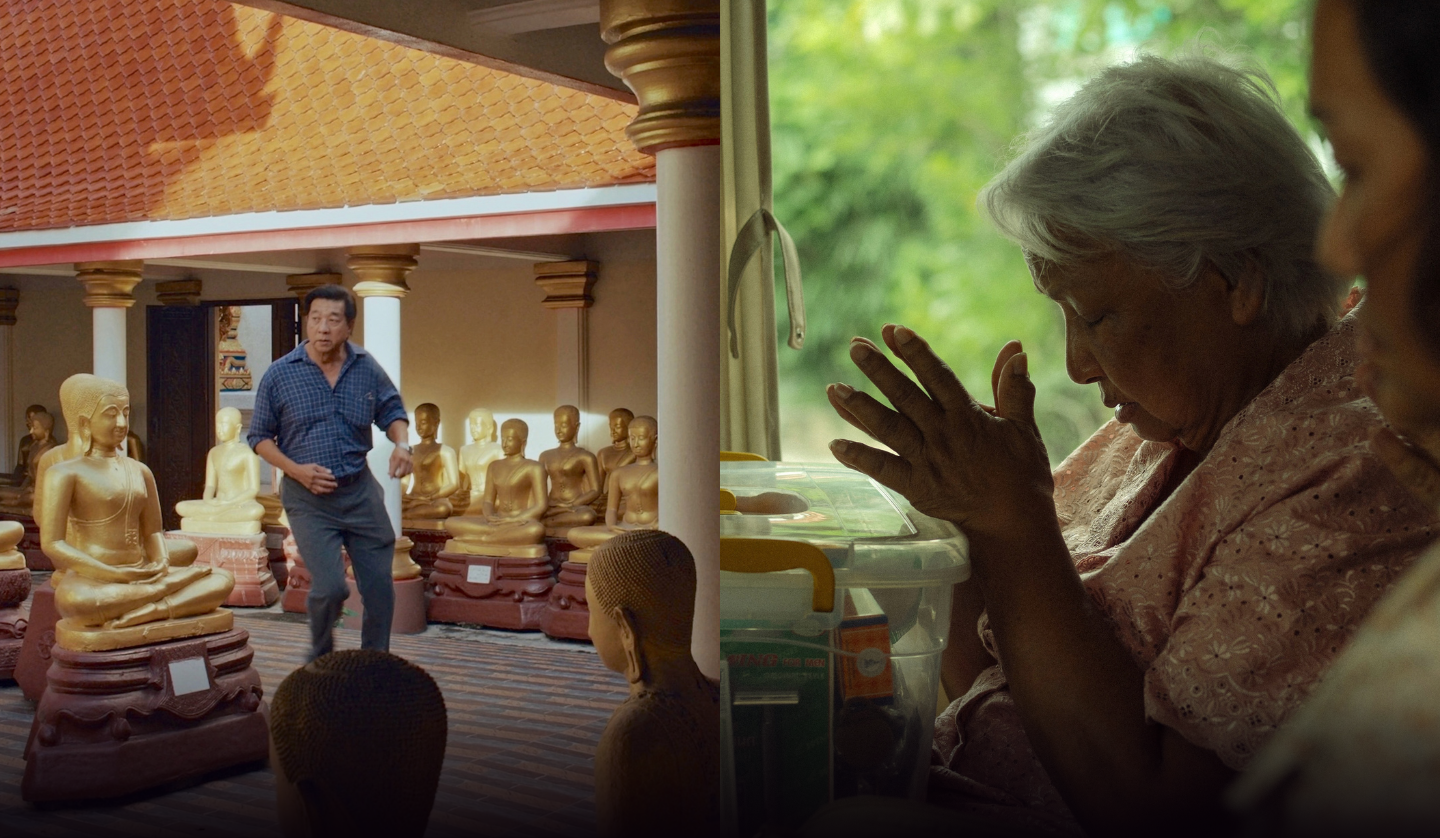
This review contains potential spoilers.
The film opens, neither with an establishing shot nor a close-up of a character’s countenance, but with a haunting baritone vocal, an eerie, resonant longing from the past, that of luk krung master Suthep Wongkamhaeng, filtered through an old gramophone. It’s the standard ‘Phiang Kham Diao’, the original version, which was recorded in 1955:
Just one word that I desire
to hear to fill my heart with joy
my mind anxiously lost in reverie
Then, a Buddhist altar is gradually drawn from pitch darkness as each light set is switched on by someone off-screen. Grandma Saluay (Amara Ramnarong) – as confirmed by a funeral officiant nearby – is dead, and we are apparently in the midst of mourning. The film thus begins with the sonic (though non-diegetic) presence of an absence: a death in the family, surely not yet completely processed by the remaining members, whom we do not get to see at this time, marked only by the sputtering of a vinyl record spun from elsewhere. It is a plangency equal in intensity to the certainty of death itself – the harshest of all facts of life.

Discerning viewers might recognise this technique of establishing a soundscape preceding even the emergence of a first image in Apichatpong Weerasethakul’s works, perhaps most memorably in Uncle Boonmee Who Can Recall His Past Lives (2010), as well as the use of luk krung music, prominent in his debut Mysterious Object at Noon (2000). These similarities are hardly surprising given the producer credits (Apichatpong himself alongside Kissada Kamyoung, who had previously worked with him) and the professional background of director Sompot Chidgasornpongse, who began his career in filmmaking as a second cameraman and intern on The Adventure of Iron Pussy (2003), Apichatpong’s campy outlier.
But all of this is more than a brief homage to one of the most well-known slow-cinema auteurs in recent memory, whether intentional or not. ‘Phiang Kham Diao’ is about the singular power of a word that is so captivating it can send a yearning lover into a trance-like state, or rather, about the inscrutable qualities of such a word. That word is probably ‘love’, in the way a crooner conceives it and what Suthep likely had in mind when he recorded the song. In the film, however, that one word rests at the very heart of the story. It is the word you might want to say to a family member who has had their share of misunderstandings with you in the past, that gaping rift that made you cold to one another. Perhaps you hope in vain that this one word will mend the relationship, a fix which you think is long overdue. Yet it is another sadness altogether if you utter it too late, that is, after they have passed into the next life (if you are a Buddhist), a heavenly realm or an infinite nothingness.
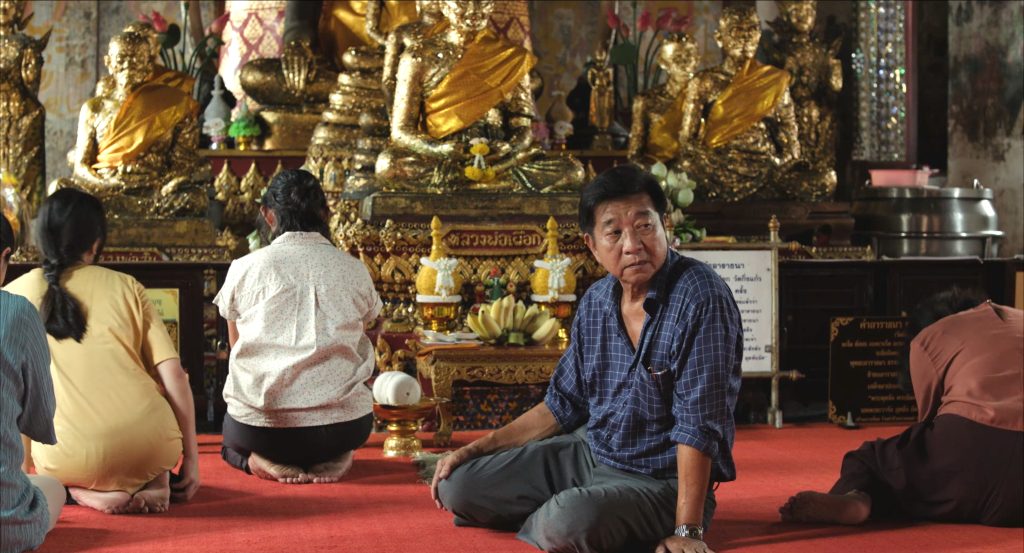
Given that ‘Phiang Kham Diao’ bookends the film, the key to understanding this new drama by the team behind At A Time Pictures and Kick the Machine Films – ostensibly about a family pilgrimage to make merit at nine temples, and which is Thailand’s Oscar entry for Best International Feature Film this year – seems to be kept hidden within the breadth of that single word. It is a word we might feel too proud to tell someone, or too timid to proclaim in the open. The affective ineffable is forever out of our linguistic reach.
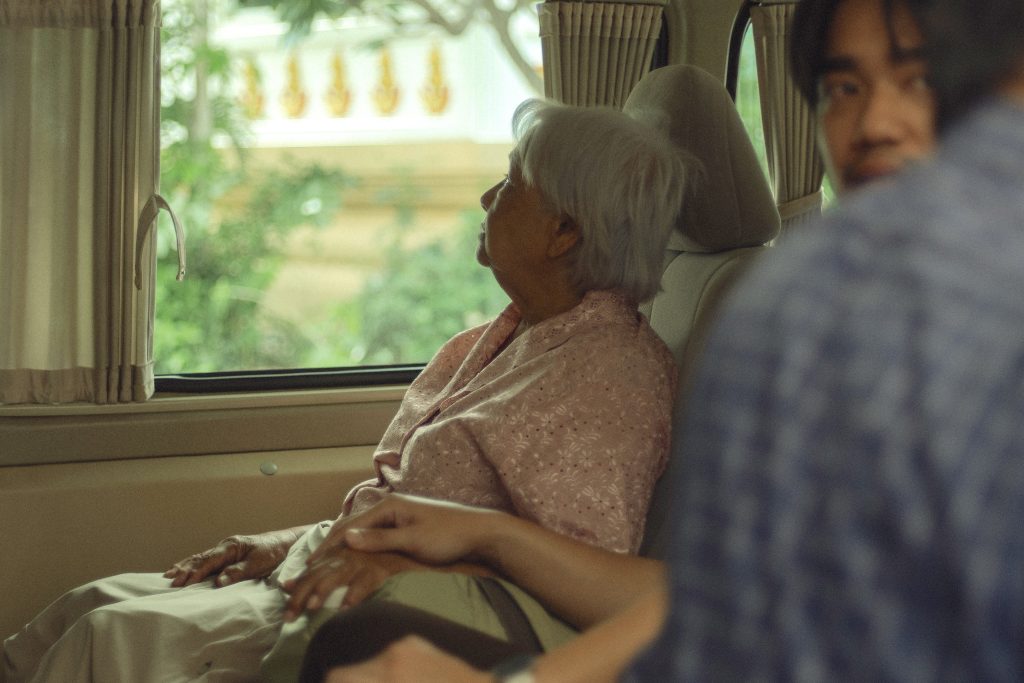
On the surface, the story of 9 Temples to Heaven is very straightforward, almost too simple for a film this length. After the funeral preparation opening sequence, we are thrown back to a certain point in time in the past, meeting Grandma Saluay in the flesh. Sakol (Surachai Ningsanond), her eldest son, is taking her and the family on what could be described as a pilgrimage – not on foot in the traditional sense, but by car – to make merit at nine temples, all in a single day, around regions outer to Bangkok. (After a brief chat with the director, I learned that it was filmed in Samut Prakan, not far from the capital.)
Accompanied by his brother Pongpol (Jirawut Chiwaruck), his wife Anchalee (Klaichan Phunman), his sister Wimol (Yaneenan Jiraphatjittrin) and his children (Sompop Songkampol, Poon Sirapob and Nichmon Shintadapong), along with his eldest son’s girlfriend Yam (Yada Karnjanisakorn), the travelling group consists of nine people exactly. It seems hardly coincidental that the number of family members matches the number of temples he plans to visit. But, as the film goes on to probe, whether this holds any meaning at all for Grandma Saluay’s well-being or her entry into so-called ‘heaven’ – a dubious enough concept even in Theravada Buddhism – is highly suspect.
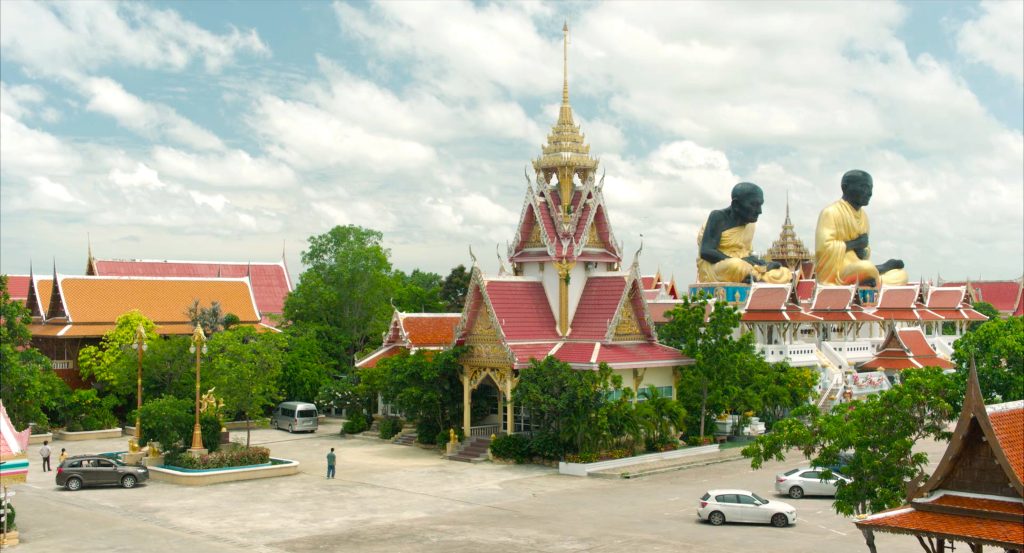
The structure of the film makes it, as many have observed, a ‘road movie’, joining the likes of Little Miss Sunshine (2006) and even Wim Wenders’s own adaptations of the specifically American genre, but it is the former with which this film has more affinity. Inside the confines of the van, we feel the weight of time as it courses through. The open road sprawls with ordinary commuters, sharing a path with Sakol’s family as they gamble with life, death and a potential afterlife. Images of factories, industrial buildings and smokestacks appear, contrasting with Buddhist architecture.
Modernity and pre-modernity meld together, and Samut Prakan itself seems like a transit point where you either stop for a temple visit or a petrol refuel: straight roads, lampposts, headlights, highways, motorways and crossroads. The linearity of time is infused into the geography of the province, which feels like an extension of Bangkok – not a place in its own right, but a non-place where solitary individual experiences replace collective meaning. This can be seen in the film’s emphasis on Grandma Saluay’s subjectivity in certain scenes. Like meditation, watching the road stretch on and on puts us inside our own heads.
Within this narrow, almost claustrophobic passenger compartment, human drama arises without contrivance. Arguments over belief and emotional pleas build crackling tension as one worldview clashes with another. There is a neorealist sensibility that blurs the line between fiction and fact, between narrative film and documentary, the latter being familiar territory for Sompot. The casting of non-professional actors (many of whom hold regular jobs), the impromptu nature of the dialogue and even the director’s integration of his own experience with meditation border on metatextual awareness.
Critics have praised the ‘naturalness’ of the acting, but one scene in particular calls this into question. Sakol’s middle child, Koon, while reflecting on past suicidal thoughts stemming from his experience with meditation, suddenly declares “nothing is real” and knocks lightly on the camera lens. His solipsism almost takes hold of him. Indeed, even with this documentary sheen, the film becomes a commentary on its own filmmaking process. The sense of immediacy is, as it argues, always mediated, constructed and fundamentally false. The sound design, the dialogue and a host of other naturalistic elements almost lead us to believe that what we see is real, even though we know it is not.
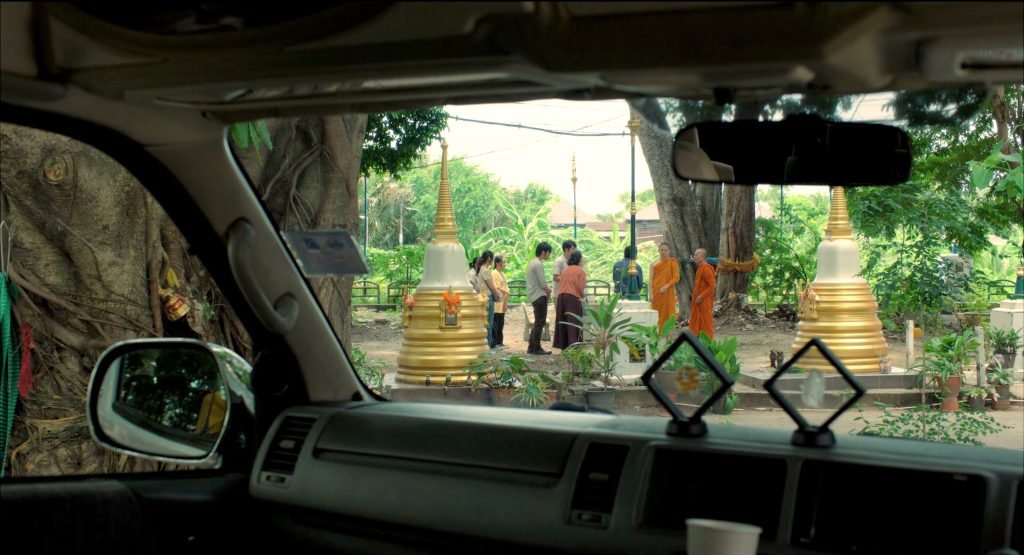
There is a light-footedness, a nimbleness to its meditative cinematography. It is slow – in the sense of the popular descriptor ‘slow cinema’ – but not plodding. The runtime flies by when one is not paying attention. Perhaps this is the lesson: to be a student of cinema is to be, at the same time, a student of life; to be attentive to all details, however minute, is to be situated in the Now, which is also among the well-known lessons of Theravada Buddhism.
One could argue that 9 Temples to Heaven is about, among other things, anticipatory death: the fact that we know we must die and the preparation that leads to it, a ‘second death’. No one is actively dying on screen; Grandma Saluay’s death transpires over an interval of years (or months) that we do not see. The act of dying is unexpected, but the fact that we will die is not; it is concrete and final. Death is the culmination of a lifetime of everything done hitherto. And it is personal. As much as you want someone to understand you or console you, you are, alas, alone in that great reckoning. The last thing you possess and finally learn to let go of is your own death, the final meaning of which you are the sole judge to determine. This likely explains Grandma Saluay’s stubbornness – her wish to go home and break with Sakol’s plan, and her later wish to continue on the merit-making trail after being sent home. It is her way of expressing autonomy and determining how her remaining days will play out.
And here is a frustrating thing about us humans. The certitude of life grants us foreknowledge of our demise – not when, but that it must happen – yet we are still unnerved by the very thought of it, our desire to escape it expanding ever larger. Here is another thing about us: we know that fiction does not exist in reality and that what is shown to us is the result of deliberate stylistic choices, yet it completely destroys us and knocks our socks off every time. We feel what the characters feel as if we were as real as they are, which is to say, not real at all. This is the angle of artificiality around which the entire film pivots, apart from being a portrait of a family with its own personal conflicts, clashing beliefs and contrasting personalities, and apart from being an examination of Theravada Buddhism in contemporary Thailand.
9 Temples to Heaven is now playing in theatres.

Escape Bangkok for Thailand’s 7 best national parks. Discover wildlife, culture and ...
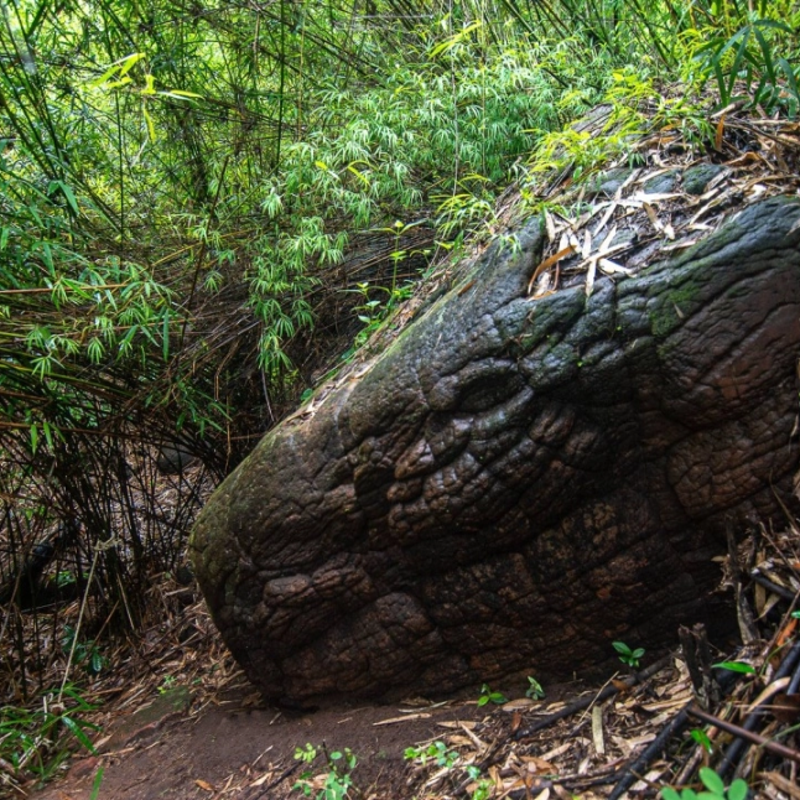
A detailed guide to hiking the Naga Cave, combining physical challenges with ...

Thai filmmaker Apichatpong “Joe” Weerasethakul receives France’s highest honour, the Legion of ...

Sailorr and Molly Santana’s black grills fuse hip-hop swagger with homage to ...

Treat your favorite furry companion some stylish goods Did you ever think ...

Koktail celebrates the sixth edition of The Future List with 100 Future ...
Wee use cookies to deliver your best experience on our website. By using our website, you consent to our cookies in accordance with our cookies policy and privacy policy


