Weekend Getaways
7 Must-Visit National Parks in Thailand and How to Explore Them
Escape Bangkok for Thailand’s 7 best national parks. Discover wildlife, culture and ...




Ready to swap Bangkok’s exhaust fumes for actual oxygen? Thailand’s national parks are a great antidote to city burnout, offering a massive dose of wilderness. Beyond the flora and fauna, these lands are deeply connected to the history and traditions of the indigenous communities who mastered these forests centuries before tourists arrived.
To help you ditch the concrete, Koktail has rounded up seven of the best national parks in the country. We’ve mapped out the highlights and essential tips – whether that means dodging a multi-ton elephant roadblock or showing proper respect to the indigenous communities who call these mountains home.
If you’re looking to feed your soul (or just your Instagram feed), this spot hits the trifecta: deep spirituality, Buddhist architecture and sweeping views of downtown Chiang Mai. Apart from the pagodas of Wat Phra That Doi Suthep, the national park whips up a misty backdrop that turns a standard hike into something out of a daydream. For an endurance test of body and spirit, take a detour down the Monk’s Trail. Just think of it as a moving meditation with a side of steep inclines.
But if camping is more your speed, the high-altitude site near the Doi Pui summit is the ideal spot to pitch a tent and watch the mountain clouds roll by. Just a short spin down the road sits the Doi Pui Hmong Tribe Village, where you can support the local community by picking up some handwoven bags and colourful textiles. Basically, the national park splits into two perfect vibes: a serene forest filled with ancient temples and a vibrant cultural escape that connects you right to the highland locals.

Here is the lowdown on the ticket prices. Starting last year, the park switched over to the standard system used all over Thailand, so rates depend on whether you are local or visiting from abroad. Thai residents pay THB 20 for adults and THB 10 for kids, while international visitors pay THB 100 for adults and THB 50 for kids.
You’ll also want to skip the “burning season” – which usually runs from January through April (and sometimes stretches into May) – since the heavy smoke makes hiking tough and definitely isn’t great for breathing. Also, a quick heads-up if you plan on camping: the Doi Pui campsite is temporarily closed for its usual seasonal break right now, but you can always grab the latest reopening dates directly from the park’s official Facebook page.
The main draw of Erawan National Park is its famous seven-tiered waterfall, which spans over two kilometres through dense jungle. Each tier has its own personality. For example, at Tier 2, you can dip your toes in the turquoise water and get a foot pedicure from the fish that nibble away at your dead skin.
As you keep hiking up the trail, the terrain gets a bit more tricky. Further up at Tier 4, the forest opens up to reveal smooth boulders that form natural rock slides. Then, you reach Tier 7, Phu Pha Erawan. The summit pool is named after the three-headed Hindu elephant because, if you step back, the cascading water pouring over the curved limestone formations looks just like it from a distance.

The national park is open from 8am to 4.30pm, so night hiking is out of the question. Keep in mind that life vests are mandatory if you want to swim, and red flags mark dangerous zones with torrential currents you need to avoid. Also, alcohol is strictly prohibited.
If you love wildlife, Kaeng Krachan National Park belongs at the top of your list. The park plays host to roughly a million butterflies around the Ban Krang Campsite, and they are notorious for fluttering right up to greet passing visitors. If you don’t consider yourself part of the lepidoptera crowd, the area is also a paradise for birdwatchers, boasting around 450 different species.
For a completely different vibe, set your alarm early and head up Khao Phanoen Thung. An eight-kilometre trail brings you right to the park’s second-highest peak at 1,207 metres above sea level. The sweeping views of the ‘sea of mist’ rolling through the valleys pair well with a warm morning cup of joe.

No motorbikes or bikes are allowed inside the national park, so you’ll need a four-wheeled vehicle to get in. Keep in mind that Ban Krang Campsite and Khao Phanoen Thung shut down every year from 1 August to 31 October to give the animals some peace of mind. Flash floods can also shut things down out of nowhere, so definitely keep an eye on the weather before you go.
If you are a history buff, the park’s must-visit spot is Phraya Nakhon Cave. Hidden deep inside this cavernous chamber is the Khuha Kharuehat Pavilion, a royal shrine built back in 1890 for King Chulalongkorn (Rama V). Right above it is a natural bridge morbidly dubbed the “death bridge”, thanks to the unfortunate animals that have fallen through it.
Time your hike for the 10.30-11.30am slot when the sun becomes like a dramatic spotlight, bathing the pavilion in a harsh, celestial glow that accentuates its holy vibes. The park is also famous for its resident dusky leaf monkeys. They are so ridiculously cute that watching them forage will absolutely trigger your urge to smuggle one home in your backpack.

The trek to Phraya Nakhon Cave is no joke. It’s a genuine leg-burner. They say the holiest paths are the most treacherous, and this one is certainly trying to convert your fitness level into pure sweat. Plan on at least an hour of huffing and puffing, though it might take longer than that. Entry to this holy site costs THB 200 for adults and THB 100 for children, while Thai nationals pay THB 40 for adults and THB 20 for children.
This one is strictly for the (artificial) lake lovers. If you’ve ever wanted to cast yourself as Kevin Costner in Waterworld (1995), booking a floating raft on Cheow Lan Lake – aka the Rajjaprabha Dam Reservoir – will absolutely give you those epic, water-bound vibes.
Massive limestone towers shoot straight up from the deep like giant, prehistoric sprouts. The water is a shade of emerald so mesmerising you’ll be torn between diving straight in and leaving the surface tension perfectly untouched just to admire it.

Don’t expect a five-bar internet connection or Wi-Fi out here. While the urge to immediately dump these views onto your Instagram feed is real, this is your sign to actually touch grass and enjoy the present moment offline.
Just make sure to lock in your plans well in advance if you are visiting during the peak season from December to April – unless you want to share that rare moment of zen with a massive horde of fellow tourists.
This one’s a classic. If you ask someone to name a national park in Thailand, this probably comes first on the list. It’s Thailand’s oldest national park and is classified as a UNESCO World Heritage Site. The wildlife here is plentiful: wild elephants, gibbons and deer. One would go here to reconnect with nature and make the acquaintance of fellow animals.
There are two major waterfalls. The first one is Haew Narok (Hell’s Chasm), but of course, it’s not as scary as it sounds. Despite the scary name, the breathtaking 150-meter, three-tiered waterfall is pure beauty. And the second one is Haew Suwat. You know, the one where Leonardo DiCaprio jumps off in the 2000 movie The Beach. Don’t attempt it, though.

Since some parts of the road have to be shared between elephants and vehicles, if a multi-ton local decides to roadblock your car, you need to keep your engine running, stop 30 metres back, smoothly reverse if they approach and absolutely avoid honking or flashing your high beams unless you want to see an annoyed elephant up close.
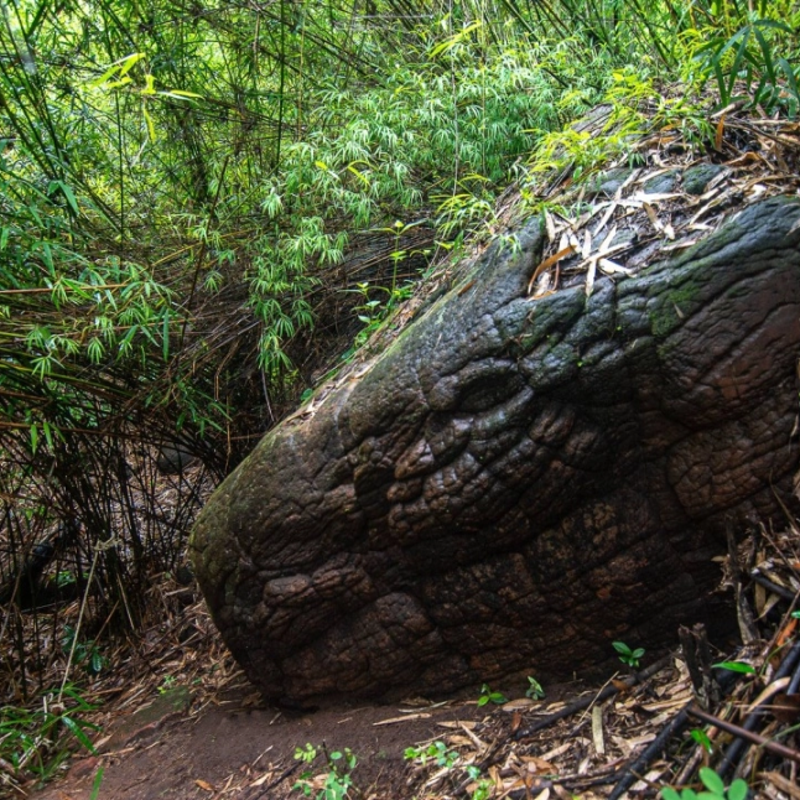
The park is a tale of two provinces, and your choice depends entirely on your crowd tolerance. On the Bueng Kan side, Naka Cave is the viral superstar, drawing legions of spiritual seekers who hike up to manifest good fortune from the legendary Naga serpent spirits. The rocks literally look like petrified dragon scales. We have covered the cave in depth in a previous Koktail feature here.
If you’d rather skip the pilgrimage traffic, turn to Nakhon Phanom’s Nakee Cave. It offers the exact same awe-inspiring, reptile-skin geology but lets you appreciate its star attraction: a boulder shaped like a giant python head in absolute, eerie peace.

You will absolutely need a local volunteer guide for the trek; while there is no fixed fee, tipping around THB 500 is standard practice – though you can certainly give more if they do a fantastic job. Also, leave the flip-flops at the hotel. You will want sturdy closed-toe shoes to protect your feet from sharp, jagged rocks inside the cave.

Escape Bangkok for Thailand’s 7 best national parks. Discover wildlife, culture and ...
A detailed guide to hiking the Naga Cave, combining physical challenges with ...

Thai filmmaker Apichatpong “Joe” Weerasethakul receives France’s highest honour, the Legion of ...

Sailorr and Molly Santana’s black grills fuse hip-hop swagger with homage to ...

Treat your favorite furry companion some stylish goods Did you ever think ...
Tanat Sangaramya reviews 9 Temples to Heaven, Sompot Chidgasornpongse's new film on ...
Wee use cookies to deliver your best experience on our website. By using our website, you consent to our cookies in accordance with our cookies policy and privacy policy


