
Weekend Getaways
7 Must-Visit National Parks in Thailand and How to Explore Them
Escape Bangkok for Thailand’s 7 best national parks. Discover wildlife, culture and ...



VERY THAI: Thai literature dwells mostly on Thai topics, but a new crop of globalised Thais is writing in English about universal subjects. In his periodic column, Philip Cornwel-Smith, author of the best-selling Very Thai and Very Bangkok, meets two Thais whose cosmopolitan books focus on Singapore and Africa.
Thailand’s reading culture is on the up, though literature is yet to get a soft power push. That’s partly due to language, partly due to an understandable focus on Thai topics, even among the accomplished Thais writing in English. Now a new echelon of transnational Thais is writing about subjects relatable to a global readership.
October’s 31st National Book Expo and April’s Bangkok Book Fair always attract thousands of buyers and browsers. While they feature book launches and ever more classics in Thai translation, those fairs are more about commerce than airing ideas.
Thai literary festivals tend to fade after one or two years. To see Thai writers getting platformed, bookworms need to head for Singapore, Bali or beyond. Every October, Ubud Reader’s and Writers Festival usually showcases one or two Thais. Last year there I interviewed Singapore-based Thammika Songkaeo and the half-English luk khreung Alex Chula, who both write for Western publishers in English about edgy themes.

Part of a growing Thai diaspora, Thammika wasn’t educated in Thai, but has spent most of her life abroad as a diplomat’s daughter, speaking various Englishes in India, Uganda, Rwanda, at international school in Bangkok, then in America and since 2014 in Singapore. “I can switch accent when I need to. And there’s a more neutral one when I’m not in an Anglophone country,” she said on a panel about innovation in language.


Her debut novel, Stamford Hospital (2024), ruffles the affluent expat milieu of Singapore. The story spans the three days that a woman with a derailed career checks her daughter into hospital for an ambiguous ailment. That medical limbo provides enough respite from burnout – due to her stiflingly ‘perfect’ lifestyle and family – to crystallise what she terms “the cost of selfhood” for women.

“A brain can carry only so much that it can’t run away from,” she says, noting that this composite novel is not memoir. “Three days and two nights is enough to understand the weight of suffering on a human. Emotionally, maybe we can never take a break.”
The underlying thread is a common one: the thwarting of women’s ambition. One passage tackles the weight of Thainess expectations. “What happens to Thai women who have been internationalised? What values do they represent and what values are they advocating for, especially for themselves?” Thammika asks. “A group of Thai women have learned the value of equality, will fight for it and are not going to accept material furnishings as a thing that completes their life. They will struggle and they will probably suffer.”
This message resonates with many ambitious women trailing their spouse across the globe. It’s a much-heard complaint in Bangkok. “I wanted this book to make women feel less lonely. And when loneliness is dark, it can get really dark.”
Women have reached out to her from several countries. “I thought, if this book gives them another day and a feeling of being understood, maybe there’s a hotline there?” Now she’s using the book to fundraise for a women’s hotline tied to a group that represents older women in media. “The publishing industry has trained us female authors who are about 40 to be anxious about turning older.”
While Thammika taps a widespread predicament, Alex Chula’s literary non-fiction couldn’t be more wildly specific. An Anglo-Thai raised in England, Chula (surname Suebsaeng) is a classical scholar turned medical doctor. Unexpectedly, he built a bond with Malawi, a landlocked sliver of East Africa.
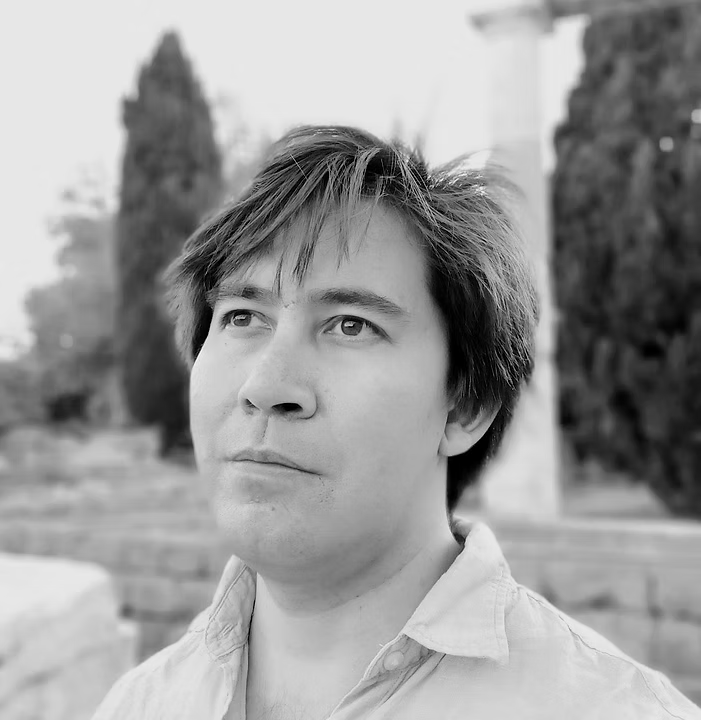
“I had a fanciful idea to go to Africa. It would have been easy to become an aid worker, but I saw an advert for a teacher of Latin and Greek in Malawi, which was probably the only job in the entire continent I was actually qualified to do,” he recalls. “There’s an academy deep in the Malawian bush. It was founded by this very eccentric dictator Hastings Kamuzu Banda in 1981, specifically to promote the study of Greco-Roman civilisation as a way of advancing development in Africa.”


Banda had died 12 years before Chula arrived at “The Eton of Africa,” but the dilapidated Kamuzu Academy felt like a Homer away from home. “I became infatuated with Malawi,” says Chula, who reluctantly returned to the UK after three years to study medicine. As a doctor, he returned back and forth for over a decade, and visits Thailand often.

In eerie parallels, Banda had likewise left his homeland young, graduated in classics and later became a medical doctor. Those “strange and quite uncomfortable affinities” drove the memoir aspect of Chula’s hybrid biography. But ‘Goodbye, Dr. Banda: Lessons for the West from a Small African Country’ (2023) is also acclaimed as a polemic about how Westerners interact with other cultures.

“I was never fully at home in either the English or the Thai cultures. I don’t think I could have done my writing without that outsider’s perspective,“ Chula reflects about his own multi-cultural heritage. “I was drawn to Banda’s own preoccupations with cultural belonging.” Banda re-established his African roots and preserved traditions, yet obsessively synthesised Western values in his own idiosyncratic way. In a life neatly spanning the 20th century, this philosopher-king morphed into a totalitarian tyrant -– banning opposition, beards and shorts – staining his status as an anti-colonial hero.

Literature is being decolonised too. The dusty Western canon is being refreshed by classics from the Global South. Prizes and professorships are going to authors outside the Anglosphere. Never colonised, Thailand has a unique standpoint, though its soft-spoken, deferential culture restrains Thais from peeping above the parapet.
Literary festivals also turn featured authors into pundits on topical issues. In a panel on ‘Deconstructing Colonialism,’ Chula played the independent gadfly, skewering both the colonial and post-colonial legacies. “I’ve become conscious of how self-absorbed, self-obsessed much of the discourse on colonialism is,” he notes. “A big part of my book is vehemently challenging that narrative… It comes from a very particular academic sphere. It’s Westerners castigating themselves for this thing they perpetrated. They lose sight that it has been practiced by a vast array of societies for all of human experience and across the world today. Many pernicious forms of colonialism end up receiving so much less urgency than they deserve.”
Chula cites how Malawi, one of the ten poorest countries, recently had to pay wealthy Omanis to repatriate 50 trafficked women held in drudgery. “Arab colonialism in East Africa is resurgent right now, but specifically the slave trade was only stopped for a brief period by British rule, and had been going on for centuries before.”
Malawi had been a pool of labour for Zanzibar, where the world’s biggest slave market got closed down by missionaries, who built a cathedral on its site. “The record of some of these missionaries in not just eliminating slavery, not just risking their lives, but the way they recorded local cultures, studied them, celebrated them, is so more respectful and curious than anything we have today. It’s the opposite of contempt.”
Chula reckons the term ‘colonialism’ is unravelling. “It’s got such toxic connotations, but people have used it so loosely. Colonialism is a wildly heterogeneous phenomenon. When people turn it on Thailand, we need to get a grip. Thailand did not have a colonial experience. What we’re talking about is modernity. Every country has this massive experience. I’d say Thailand embraced modernity a lot less traumatically than many other societies, which means they don’t feel the need to harp on about it.”
By getting published, a writer becomes a public intellectual. That brings kudos for the expertise, but also exposure to criticism. Advocating a non-conformist position invites debate, even controversy, which Thainess typically avoids. As Thammika points out: “Change is not made by posting on social media; change is made in conversations. Via writing, you can actually have a conversation.”
Elevated into the international commentariat, Thammika spoke at Ubud on panels about debut novellists, the evolution of language, and identity in the digital era. She got a grant as a National Geographic Explorer. Among ten must-reads for International Women’s Day 2025, Prestige magazine listed her alongside Margaret Atwood and Simone de Beauvoir. That’s provocative company.
Thammika has been invited back to moderate panels at UWRF 2026, which runs from October 21-25. Nattanai Prasannam, a professor in contemporary literature and screen studies, will also talk there about Thailand’s biggest soft power hit, Boy’s Love books and films.


The world is primed to hear Thai takes on public issues. Both Thammika and Chula have advocated discomfiting stances from a Thai outsider perspective. It’ll be revealing to see which other Thais step up to project their voice.
31st National Book Expo, Queen Sirikit National Convention Centre, Bangkok. 23 October-1 November 2026. https://www.businesseventsthailand.com/tceb-event-preview/31st-national-book-expo-thailand/
21st Ubud Writers & Readers Festival, Bali, Indonesia. 21-25 October 2026. Ubudwritersfestival.com
This periodic column, Very Thai, is syndicated by River Books, publisher of Philip Cornwel-Smith’s bestselling books Very Thai: Everyday Popular Culture and Very Bangkok: In the City of the Senses.
The views expressed by the author of this column are his own and do not necessarily reflect the views of Koktail magazine.

Escape Bangkok for Thailand’s 7 best national parks. Discover wildlife, culture and ...

A detailed guide to hiking the Naga Cave, combining physical challenges with ...

Thai filmmaker Apichatpong “Joe” Weerasethakul receives France’s highest honour, the Legion of ...

Sailorr and Molly Santana’s black grills fuse hip-hop swagger with homage to ...

Treat your favorite furry companion some stylish goods Did you ever think ...

Koktail celebrates the sixth edition of The Future List with 100 Future ...
Wee use cookies to deliver your best experience on our website. By using our website, you consent to our cookies in accordance with our cookies policy and privacy policy


