
Weekend Getaways
7 Must-Visit National Parks in Thailand and How to Explore Them
Escape Bangkok for Thailand’s 7 best national parks. Discover wildlife, culture and ...



For a park best known for morning jogs and lazy afternoons, Lumphini is about to get busy. The Bangkok Metropolitan Administration is marking two anniversaries at once: 100 years since the passing of King Rama VI on November 25, 2025 and 100 years of Thailand’s first public park. This is also the opportunity for Bangkok’s oldest park to show off its latest facelift.
Starting 25 April, things ramp up quickly with a multimedia show lighting up the newly restored clock tower. From 26-30 April, the park turns into a lineup of live music, light-and-sound displays and food stalls from all 50 districts. The whole idea is to make it open and inclusive, not just something you pass through. And if that still feels too contained, there are already plans to carry the celebrations beyond the park and into other parts of the city, a surprisingly big stage for a place built for unwinding (with the monitor lizards likely turning up to inspect the crowd, as they usually do).
Taking its name from Lumbini, the birthplace of the Lord Buddha, Lumphini Park has grown to mean much more than its religious roots. Today, it hosts just about every activity imaginable: public movie nights, open-air concerts, mass aerobics and more. Koktail brings together key moments from the park’s history and what they say about its place today.
At first Lumphini Park wasn’t meant to be a park at all; it was designed to showcase national identity and local crafts. On land formerly used for the royal ploughing ceremony, King Rama VI imagined it as a 19th-century world’s fair–style exhibition. The goal was both to honour traditional craftsmanship and promote Siam’s modern image, with its role as a public park coming only afterwards.

Unfortunately, while the Siamese Kingdom Exhibition was being prepared, King Rama VI became ill and passed away on 25 November 1925. With the planned event paused during the mourning period, it was no longer seen as suitable and was cancelled. One can only wonder what the exhibition might have looked like and how it could have influenced Siam’s image abroad.

Following the failed attempt to host an exhibition, Lumphini Park was repurposed as a leisure and amusement space. It officially opened on 7 November 1929, offering a central stage for performances, a large theatre, spaces for circus shows, amusement rides like a carousel, areas for water sports, as well as both indoor and outdoor sports venues.


Courtesy of Dmitri Kessel
It was less like a modern amusement park and more like a traditional temple fair, even though it did include rides. At the time, gambling was widely accepted as a form of public entertainment, with activities such as horse racing, card games, cockfighting and fish fighting. In fact, gambling was the park’s main source of income. However, after reforms aimed at turning it into a “public park,” the gambling license was not renewed after 1934, bringing that era to a close.
Lumphini Hall is a landmark in Thai dance culture and 1950s–60s popular life, shaped in part by Cold War-era cultural flows that helped circulate new forms of entertainment. Ballroom dancing arrived as a Western import, alongside jazz, especially swing. Luk krung music was also popular at the time. The Suntaraporn band rose to prominence with its smooth melodies and romantic sensibility, contrasting with the earthier luk thung tradition, and came to reflect the tastes of Thailand’s urban elite.


Courtesy of Bangkok Metropolitan Administration
At the same time, Thai music was negotiating its place between imitation and adaptation: whether to follow Western models or absorb them into something distinctly local. In this sense, Lumphini Hall is not only a dance venue, but it’s also a site of memory, where music becomes a bridge to the past.
It’s hard to imagine today, but Lumphini Park once had a floating restaurant sitting right on its lake, called Kinnari Nava, also known internationally as Peninsula. After World War II ended, Prasit Sin Company – the owners of the King’s Hotel – leased the park’s lake area to run a commercial venture. What followed was the creation of a floating restaurant that opened in 1961, serving Chinese cuisine and becoming part of the park’s postwar chapter of leisure and dining.


Courtesy of Chatdanai Rodp on FB
At the bow of the restaurant stood a prominent kinnari – a mythical half-woman, half-bird figure – which served as its centrepiece. The exposed upper female body of the sculpture drew criticism at the time, with some questioning its appropriateness. Later, on 13 August 1971, a fire broke out and completely destroyed the structure, marking the end of waterborne dining in Lumphini Park.
The Red Cross Fair, held every December at the park, is a popular event for both locals and visitors, and it’s been around longer than many people realise. The Thai Red Cross Society started in 1893 during a border conflict between Thailand and France along the left bank of the Mekong River, which led to heavy casualties. Aware of this, a group of Thai noblewomen stepped in and organised fundraising, collecting money and supplies to help wounded soldiers.

Their efforts led to the creation of the Red Unalom Society under the royal support of King Chulalongkorn (Rama V), which later became the Thai Red Cross Society as we know it today. One of its best-known traditions is the annual Red Cross Fair, which started in 1922 at Sanam Luang. Relocating to Lumphini Park, the fair blends charity with a festive public atmosphere, offering food stalls, games and education booths, all in support of the Red Cross.
In recent years, Lumphini Park has increasingly been used as a kind of outdoor gallery. A recent example is the Saneh Art by Songkran Festival 2026 (which you can read about here). Beyond visual art, the park also works well as a venue for live music, especially the popular Concert in the Park by the Royal Bangkok Symphony Orchestra. Orchestral music fits naturally with the calm surroundings as you watch the clouds drift overhead.


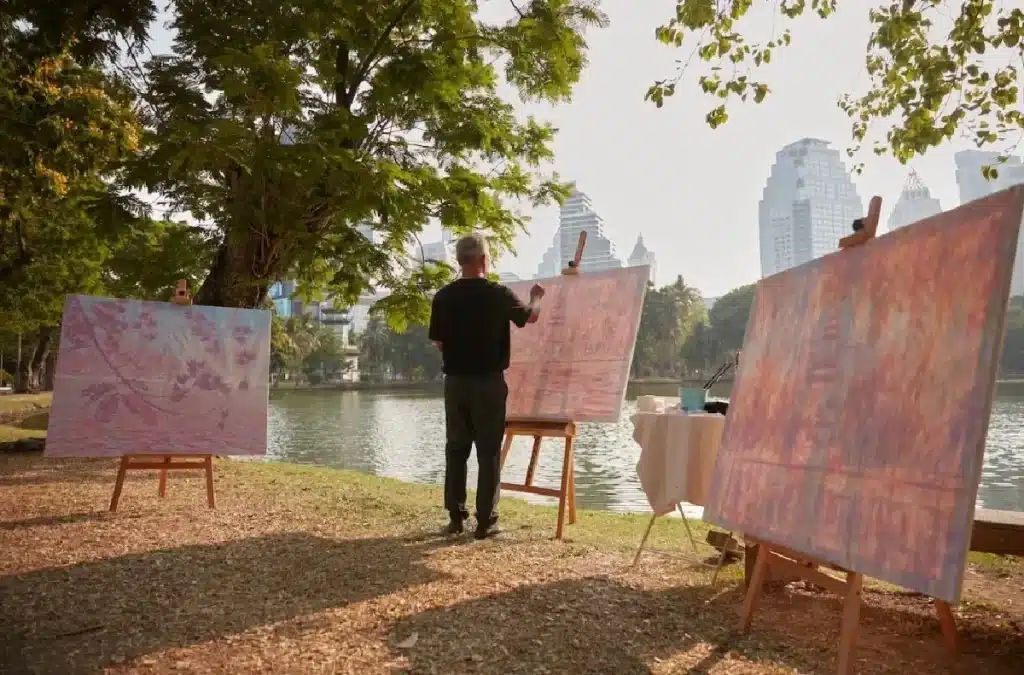

Courtesy of Bangkok Metropolitan Administration / WoodyWind
Lumphini in Impressionism is one such moment, where master painter Waravut Kaewcharoen (WoodyWind) turns his eye to the park’s fleeting scenes, capturing its light and passing moods. At times, Lumphini has also become a venue for public film screenings like Krungthep Klang Plang, drawing large shared audiences under the open sky.
On quieter days, it turns into a reading ground, with people coming to sit, read and simply be outdoors. Together, these moments show that Lumphini is a living public space, where ease of access naturally gathers people, and everyday life slips into art, film and rest.
Viral trends have also helped pull more people into the park. The unofficial mascots are the monitor lizards – basically unavoidable if you spend enough time there. If you haven’t seen one, you probably haven’t really gone wandering. These varanus are alert and always watching, but they don’t bother anyone. If anything, they’ve become part of the park’s odd everyday humour: less “wildlife encounter” and more “shared public space resident”.


Courtesy of wikipedia / _dwxmp on X
And then there are the cats. One, in particular, went viral for the way it sat deadpan by the curb, as if it had somewhere important to be but chose not to go. The internet responded accordingly, with an avalanche of heart emojis.

But it’s not just the animals. Group aerobic workouts have become a full-blown phenomenon in the park. Arguably, it got a boost from Taeyong of NCT back in February (Koktail discusses it in full here), but since then it’s picked up its own momentum. A recent highlight was Dada, Miss Grand Kalasin, stepping in as lead instructor and bringing her signature moves to the stage. It’s easily one of the biggest and most talked-about Lumphini moments in recent memory.
With growing crowds, more development is inevitable. The Lumphini–Benjakitti bridge now links the two parks, making it much easier to move between them. A new hawker centre has also been introduced to support local vendors, offering 88 designated stalls. It operates in two shifts: 5am-2pm and 4pm-midnight.

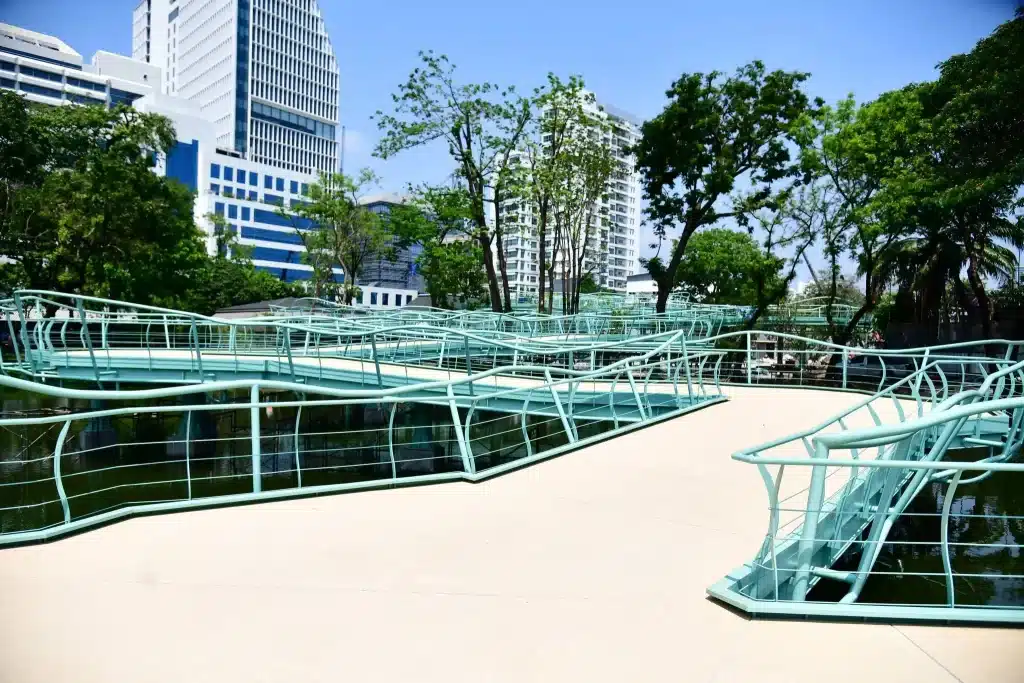
Courtesy of Bangkok Metropolitan Administration
Today, Lumphini has become a space that does it all: food, exercise, art, music and everyday social life. It’s this mix of functions that explains why it has become one of the city’s most popular gathering spots.

Escape Bangkok for Thailand’s 7 best national parks. Discover wildlife, culture and ...

Two icons of modern art come together at Dib26’s Muse: Beyond Human, ...

Sailorr and Molly Santana’s black grills fuse hip-hop swagger with homage to ...
A detailed guide to hiking the Naga Cave, combining physical challenges with ...

Treat your favorite furry companion some stylish goods Did you ever think ...

Thai filmmaker Apichatpong “Joe” Weerasethakul receives France’s highest honour, the Legion of ...
Wee use cookies to deliver your best experience on our website. By using our website, you consent to our cookies in accordance with our cookies policy and privacy policy


