
Weekend Getaways
7 Must-Visit National Parks in Thailand and How to Explore Them
Escape Bangkok for Thailand’s 7 best national parks. Discover wildlife, culture and ...



In contemporary design, objects often appear fixed. Forms become recognisable, repeatable and stabilised through culture until they are read as natural. What disappears in this process is not form but the logic that produces it – the structure that governs how meaning is made.
Creativity begins when these assumptions break. Objects stop functioning as endpoints and become sites where meaning is negotiated. Design shifts from object-making to system-making.
The work of Saran Yen Panya sits within this shift. His practice does not treat objects as isolated outcomes, but as expressions of what he calls the grammar of Thai creativity, a structural logic beneath visual language that shapes how meaning forms, connects and transforms.
“I’m more interested in defining the grammar of Thai creativity, not its vocabulary,”
Saran told us.
What follows is a reading of how this operates through his lens, where objects become tools for questioning fixed meanings and constructing cultural narratives shaped by design, storytelling and Thai identity.

Saran trained in industrial design at Chulalongkorn University before moving to Stockholm to study Storytelling at Konstfack University of Arts, Crafts and Design. The course takes an interdisciplinary approach, where narrative connects film, graphic design, craft and entrepreneurial practice, with the focus on moving images, writing and visual storytelling that link creative work to social context.
Beyond academia, his understanding of design also comes from lived experience, where observation and shifting context shape how he reads objects and their meaning.
“During my time in Sweden, it gave me an outsiders’ perspective. When you are inside Thailand, everything feels normal. When you step out, you start seeing patterns, what is truly Thai and what is just habit. Scandinavian design is very resolved. Thai design is not. But instead of seeing that as a weakness, I started seeing it as elasticity. Thai identity is not minimal or maximal. It’s adaptive and very spongy.”
After graduation, he returned to Bangkok and founded 56th Studio, a multidisciplinary design studio working across interior design, textiles, fashion, graphic design, set design, animation and contemporary art. His early conceptual furniture work introduced a distinct visual language that gained attention across local and international design platforms.
“I would say I started from wanting to rearrange the narrative. Objects were just the first tool. But at some point, I realised objects alone are not enough. You need context, emotion and contradiction. That is when it shifted into storytelling. Now I do not design things. I design conditions for things to exist.”

In his work objects become a way to carry meaning, rooted in local detail and cultural texture found in everyday life. His time in Sweden adds distance which allows ordinary scenes in Thailand to be seen differently and reinterpreted through his own lens.
“I find inspiration in everyday life. Pak Khlong Talat, Yaowarat, Song Wat, wandering the streets, looking at things people often overlook. Tension is also important, when something feels slightly off, and that is usually where ideas begin.”
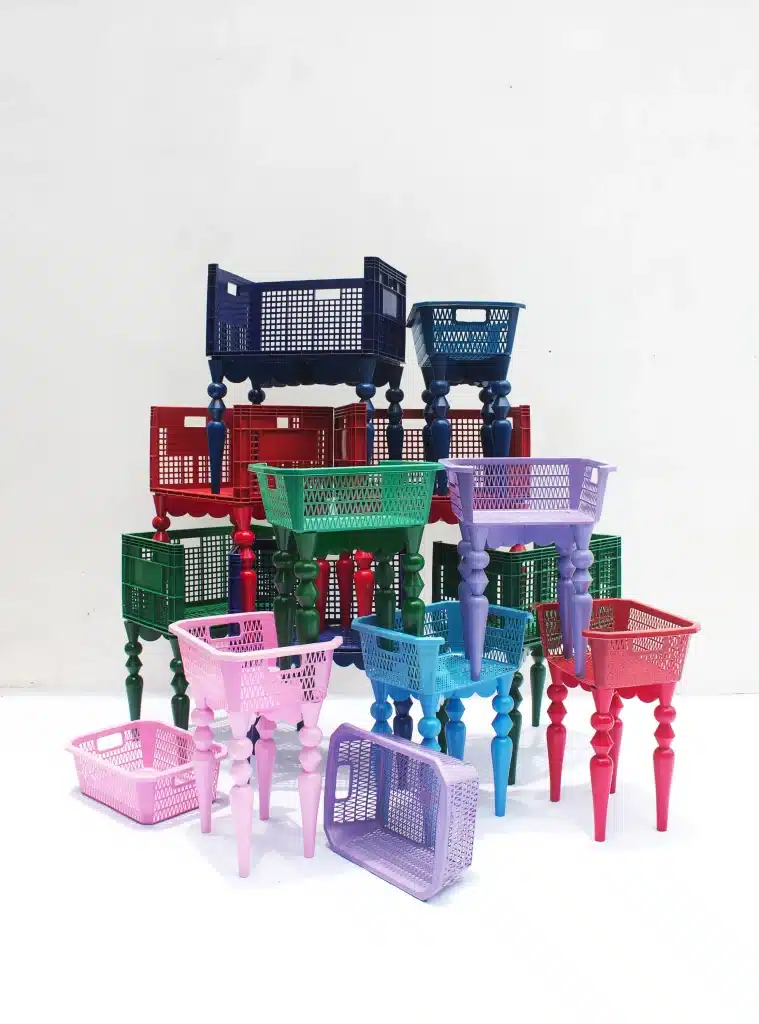
Take one of his well-known pieces, the Cheap Ass Elites chair. Built from everyday plastic baskets found in local grocery shops and combined with carved wooden legs, the piece brings together low-cost mass production and traditional craftsmanship. This contrast questions ideas of taste, value and status that reveal how they are shaped by social hierarchy rather than inherent quality. The object becomes a site where cultural assumptions are exposed and reworked.
“For my work, I like to look into tension. Cheap vs luxury. Sacred vs mundane. Order vs chaos. If those tensions are alive, the work feels Thai, even if it does not look traditionally Thai.”
Within his practice, tradition is not preserved as a fixed visual form, but understood through its underlying logic. That logic is then shifted into new contexts, so meaning evolves rather than remains static. For Saran, what matters is whether that meaning still feels alive. If it holds, the work continues to resonate. If it becomes surface decoration, it loses its depth.
“Honestly, every project that deals with Thai-ness is challenging. Because the question is always: are we representing Thailand, or are we redefining it? That tension never gets easier. But it is always very fun to tackle.”
Through this, objects in his practice move beyond function. They become a medium for questioning, translation and cultural reinterpretation, constantly negotiating between tradition and change.

This approach also defines his collaborations with international brands like Dior, where Thai materials, references and craft processes sit inside an international framework without losing their original context. The result is not fusion, but coexistence, where each element retains its identity while shifting how the other is read.
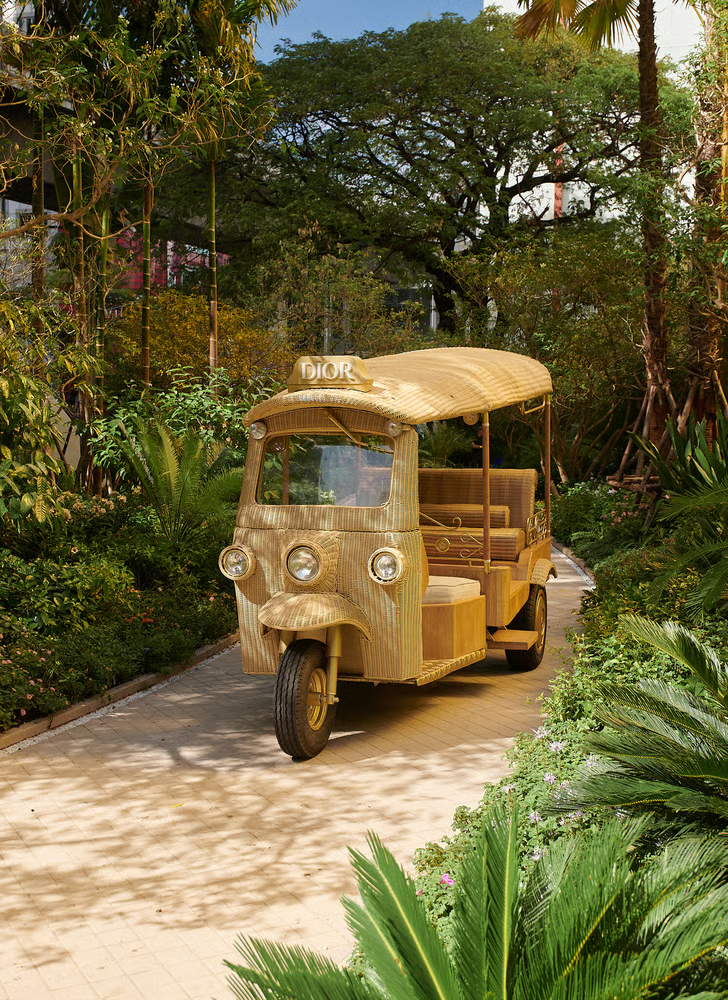
Selected as one of seven artists for Dior Gold House alongside our Future Lister Vassana Saima, Saran was invited to respond to Dior’s design language through his own lens. The project includes a tuk-tuk rebuilt with rattan and Chantaburi reed, with brass and wood details and a woven roof. It transforms a familiar urban object into a crafted cultural hybrid. The piece works as a normal tuk-tuk.
The collaboration also extends to Dior’s Medallion Chair, a Louis XVI piece long associated with the maison’s fashion presentations. Saran introduces a Thai influence without disrupting its identity through restraint and reinterpretation. An embroidered wreath detail made from natural materials introduces a new material experiment into the design. These elements come from local craftswomen, tying the work to community skill and shared labour. Saran reads Thai creativity less as a collection of visual symbols and more as a set of rules in motion, operating beneath form.
“Thai-ness is not a visual language. It’s a behavioural system. It’s how we mix things without asking permission. It’s how we make things work, even when they shouldn’t. People think Thai aesthetics is just a style, a motif. But actually, it’s highly intentional chaos.”
Another project he is especially proud of is Citizen of Nowhere, a craft project and brand built through more than seven years of collaboration with local artisans. It began with a simple question: what if Thai craft was never meant to stay fixed in place?
“So instead of asking ‘what do we preserve?’ / ‘is this OTOP?’ / ‘is this authentic?’ we ask ‘what do we choose to carry forward?’”
From there, it grew into a way of working that treats craft as something in motion. Thai makers already move between cultures, references and systems in everyday life. The project follows that rhythm, using familiar techniques and materials and reworking them into new forms while keeping their original spirit intact.
“I want to go deeper into defining Thai creative grammar. What makes something feel Thai instead of falling into cultural clichés. Not just making work, but building frameworks that others can use, reinterpret and expand. Because real impact is not what you create, it’s the legacy that continues after you are gone.”
The next chapter for Saran begins with Yenniverse, a retail space and spiritual community built from the idea of systems rather than single outcomes. It brings design, people, products and experience into one connected ecosystem, where everything exists in relation.
“Taste is not fixed. What is considered ‘good’ or ‘bad’ can be completely reconfigured. I also want to encourage people to create their own design vocabulary, form a Thai-global grammar and elevate the Thai creative industry together as a team.”


Escape Bangkok for Thailand’s 7 best national parks. Discover wildlife, culture and ...

Treat your favorite furry companion some stylish goods Did you ever think ...

Japan’s famous Tsutaya Bookstore opens at One Bangkok this October 2026 with ...

From fish sauce cookies to mala ice cream, discover the strange and ...
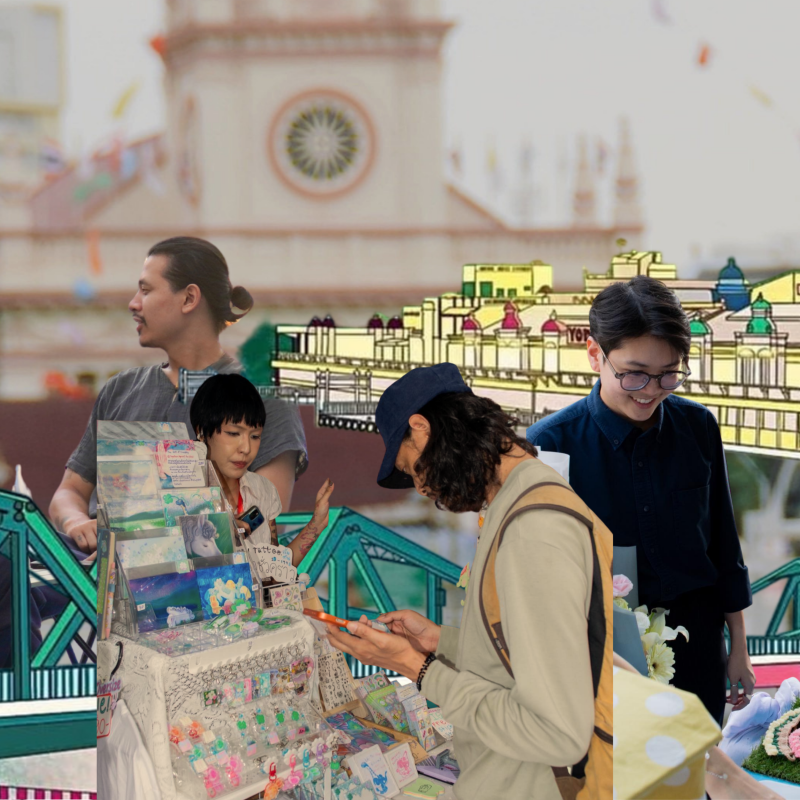
L’On Art Festival makes its debut in Bangkok with live painting, workshops, ...

From Chanel in Bangkok to Dior with A24, luxury enters new cultural ...
 English English
  Thai
Thai
Wee use cookies to deliver your best experience on our website. By using our website, you consent to our cookies in accordance with our cookies policy and privacy policy


